
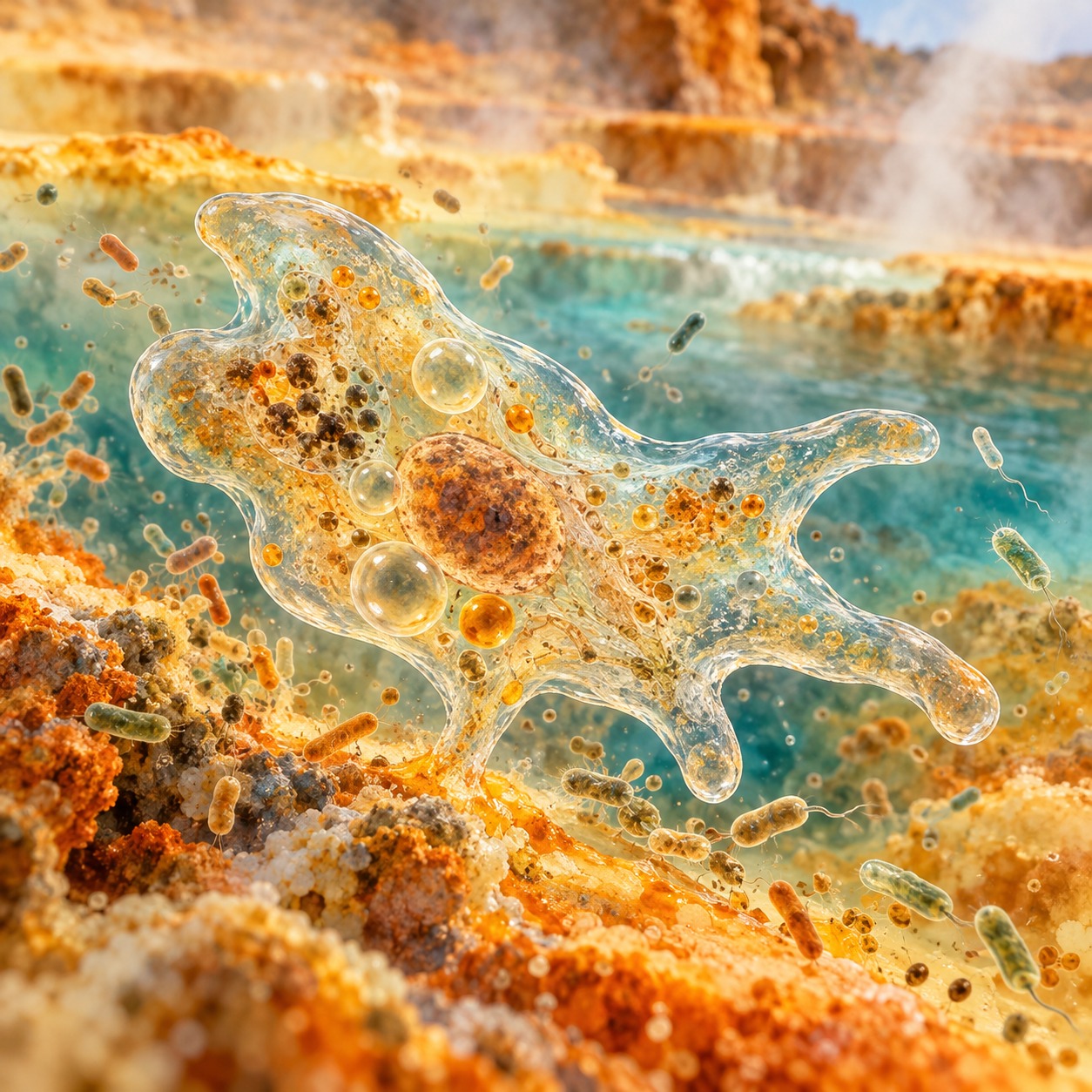

In a report published on September 22, 2026, Syracuse University in the United States revealed the existence of a microscopic amoeba capable of dividing at a temperature of 63 degrees Celsius.
This is a record for multicellular organisms.
This discovery offers scientists a new opportunity to understand the limits of life in extreme environments.
Researchers found the amoeba in a hot spring at Lassen Volcanic National Park in California.
After transferring the samples to the laboratory, they gradually raised the temperature and observed that it continued to grow and divide.
The amoeba remained motile at 64 degrees Celsius.
At 70 degrees, however, it entered a dormant state that protected it, then resumed activity once the temperature dropped.
The team named it “Incendiameba cascadenensis,” in reference to its heat tolerance and the region where it was found.
The study’s findings are prompting scientists to reevaluate the temperatures at which complex cells can survive.
Understanding how this amoeba adapts may, in the future, help in the development of heat-tolerant enzymes and materials, and expand the scope of the search for life in extreme environments on Earth and beyond.
These potential applications still require further research.