
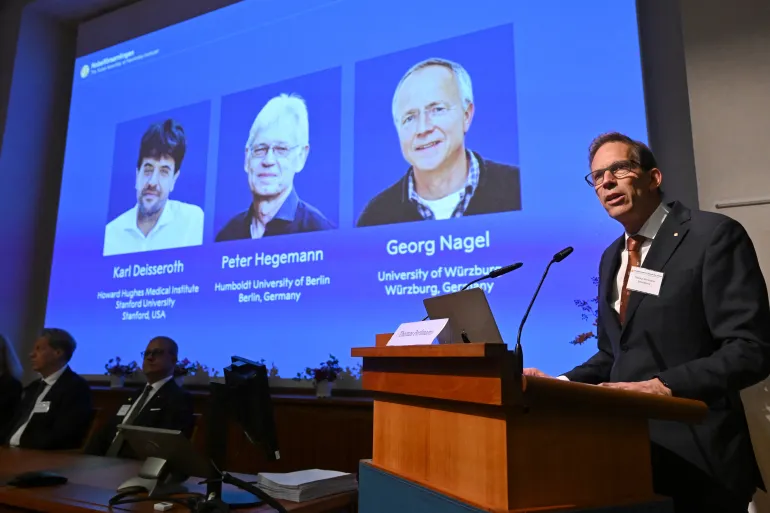

The Nobel Assembly at the Karolinska Institute awarded the 2026 Nobel Prize in Physiology or Medicine on Monday, October 5, to Karl Deisseroth, Peter Hegemann, and Georg Nagel.
The award recognized their discoveries concerning light-sensitive ion channels and the development of optogenetics.
Their research has provided precise tools for studying brain activity.
Deisseroth is affiliated with Stanford University and the Howard Hughes Medical Institute in the United States.
Hegemann works at Humboldt University of Berlin, while Nagel works at the University of Würzburg in Germany.
Optogenetics allows researchers to activate or suppress the activity of specific neurons using light, helping them understand how memories, emotions, and behaviors form within the living brain.
The story began when Hegemann wondered how the single-celled alga Chlamydomonas is able to swim toward light.
His research led him to a protein called channelrhodopsin, found on the surface of the alga’s cells.
Later, Hegemann and Nagel discovered that the protein acts as a microscopic gate that opens under blue light, allowing ions to pass through the cell membrane and generate an electrical signal.
It was also found that the protein retains its function when transferred into other cells.
Building on this discovery, Deisseroth introduced the gene responsible for the protein into neurons taken from rats.
He then used blue light to trigger neural signals on demand.
This achievement was published in 2005, and the technique was later applied inside the brains of live mice two years afterward, opening new horizons for understanding neural circuits and their role in brain function.