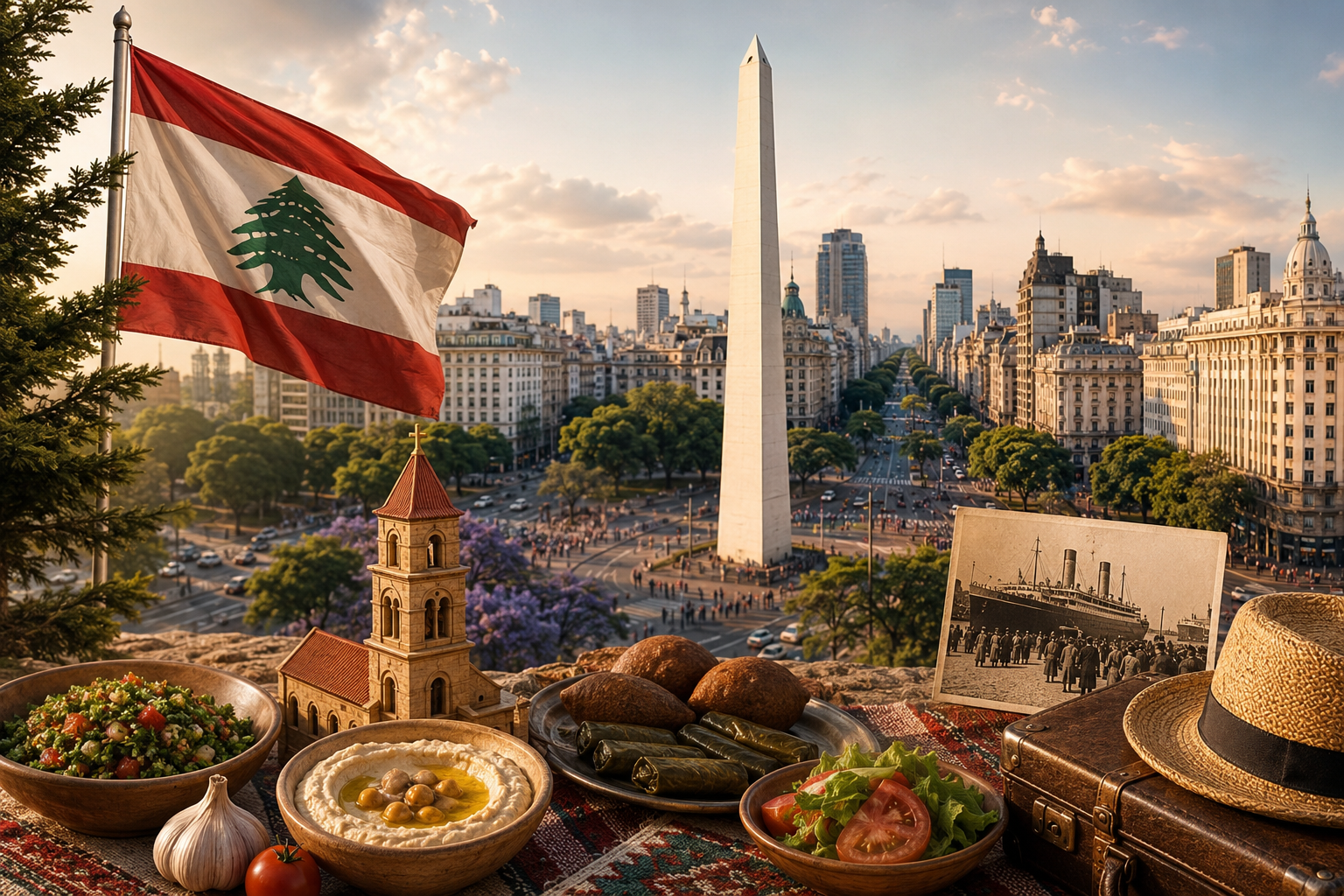

The Lebanese community in Argentina is one of the largest Lebanese communities in Latin America, and one of the most influential in economic, cultural and social life.
More than one and a half million people of Lebanese origin
In addition, the number of people of Lebanese origin in Argentina has reached more than one and a half million, according to estimates by Lebanese communities and institutions.
When did immigration start?
In addition, Lebanese immigration to Argentina began in the late nineteenth century, specifically between the years one thousand eight hundred and eighty and one thousand nine hundred and fourteen.
Where did the immigrants come from?
Among the most prominent areas from which immigrants have emerged: Zgharta, Ehden, Bcharri, Koura, Batroun, Byblos, Aley, Chouf, Saida, and Tyre.
Where they are deployed
The Lebanese community was concentrated in: Buenos Aires, Cordoba, Rosario, Mendoza, Tucumán, Salta, and Jujuy.
Professions they worked in
Upon arrival, the Lebanese worked in: mobile trade, textile sales, food trade, restaurants, and small industries.
Economic Role
However, members of the Lebanese community played a prominent role in the Argentine economy, as many of them owned large commercial companies.
Lebanese Institutions
Despite this, dozens of institutions represent the community, most notably: the Lebanese Club in Buenos Aires, the Lebanese World Cultural Union.
Political influence
On the other hand, there are a large number of MPs, ministers, and businessmen who come from Lebanese families.
Lebanese Cuisine
In addition, Lebanese cuisine is one of the most popular cuisines in Argentina. Among the most famous dishes are: kibbeh, tabbouleh, fattoush, hummus, grape leaves, shawarma, and manakish.
Integration while maintaining identity
The Lebanese community has also achieved a balance between full integration into Argentine society and preserving its roots.
Lebanese Businessmen in Argentina
Finally, Eduardo Ernikian, one of the most important Lebanese businessmen in Argentina, has his origins in an Armenian immigrant family
Read also: