
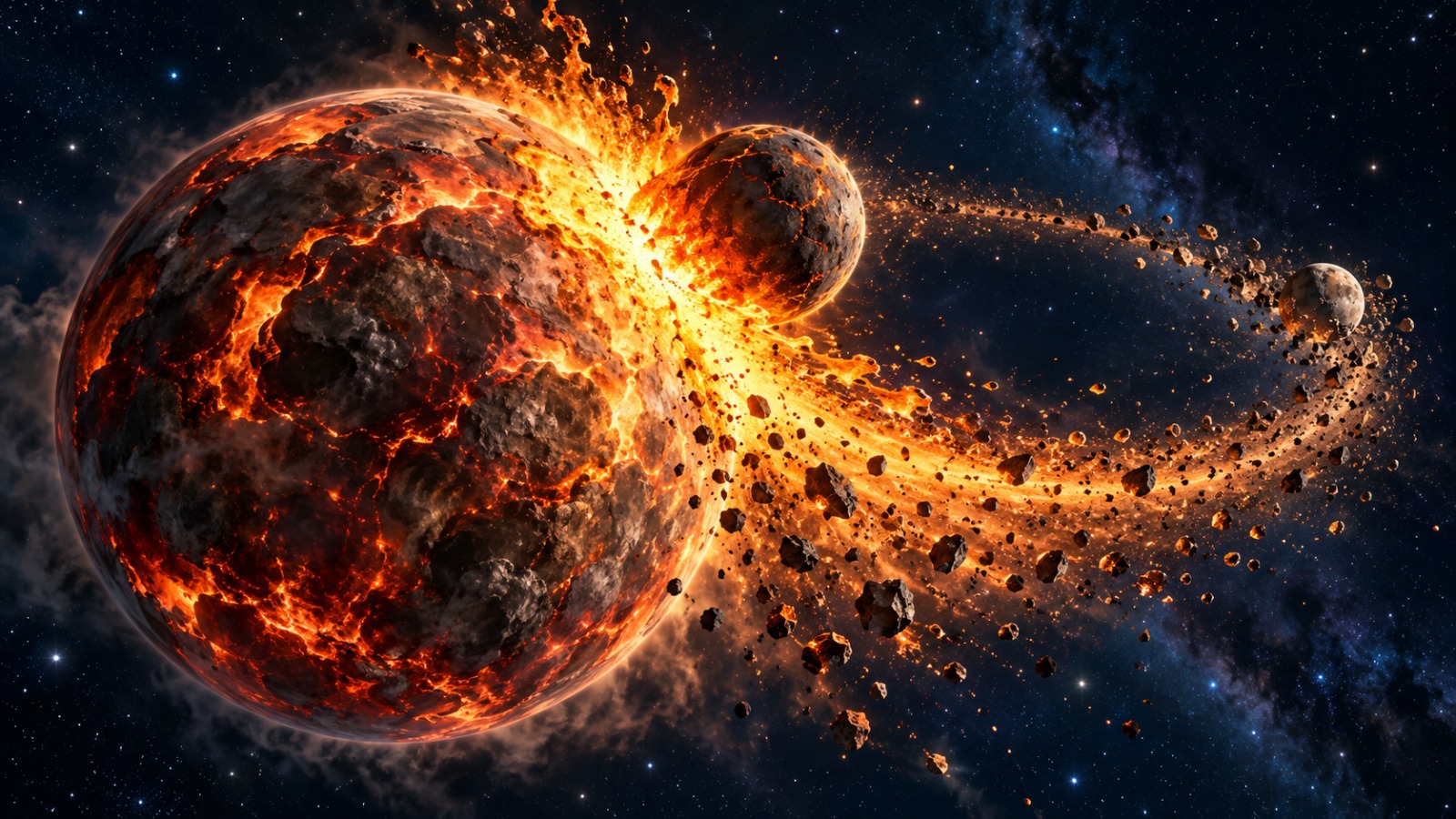

Scientists continue to investigate the origin of the Moon, Earth’s companion that has sparked human curiosity for thousands of years. The leading hypothesis suggests it was born from a massive collision in the early days of the solar system.
According to Space.com, the young Earth collided with a planetary body roughly the size of Mars, which scientists named “Theia.” This likely occurred during the first 100 million years of the solar system’s history.
How did the Moon form?
The collision ejected enormous amounts of material into Earth’s orbit. This material then came together to form the Moon. Some models suggest the process may have taken only a few hours.
The roots of the “giant impact hypothesis” date back to 1946, when geologist Reginald Daly proposed a collision-based explanation for the Moon’s origin. Researchers later developed this idea further during the 1970s, until it became the leading explanation by 1984.
Rocks reveal the Moon’s origin
The strong similarity between the isotopic compositions of Earth and Moon rocks supports the possibility that they share a common origin. The Moon also has a relatively small iron core, which is consistent with the impact scenario.
Scientists believe that Theia’s metallic core merged with Earth’s interior, while the lighter material contributed to forming the Moon.
In addition, lunar rocks contain relatively low amounts of volatile materials. Researchers link this to the intense heat generated by the collision, with evidence pointing to a magma ocean that covered the early Moon. In this way, studying these rocks helps scientists understand an early chapter in our planet’s history.