
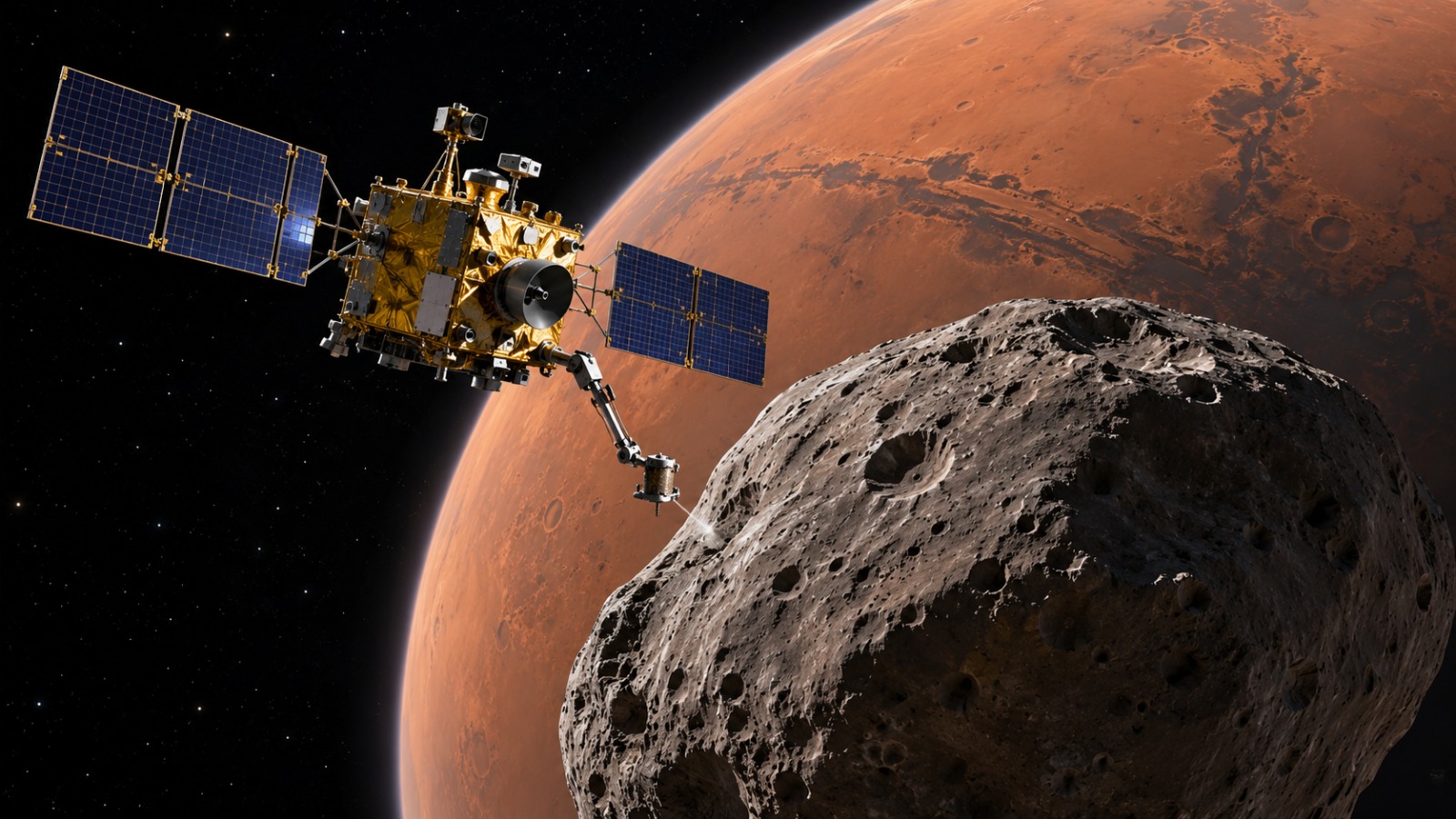

Japan has launched an unmanned spacecraft toward Phobos, the moon orbiting Mars, on a mission aiming to be the first to collect samples from this small rocky body and return them to Earth for analysis.
The spacecraft, called Martian Moons eXploration (MMX), operated by the Japan Aerospace Exploration Agency (JAXA), lifted off aboard an H3 rocket before dawn on Tuesday from the Tanegashima Space Center in southwestern Japan.
The spacecraft is expected to reach Mars in August 2027 and return the samples to Earth in 2031.
JAXA hopes the mission will shed light on the origin of Mars’ two moons and deepen our understanding of the early stages of our solar system.
Phobos, the larger of Mars’ two moons, orbits the planet three times a day.
Phobos has an irregular shape and orbits at an altitude of about six thousand kilometers above the surface of Mars.
The agency aims to collect at least 10 grams of material from its surface and return it to Earth for analysis.
This launch marks the first interplanetary mission for Japan’s H3 rocket.
The country’s flagship rocket suffered a dramatic failure on its first flight in 2023, when its second-stage engine failed to ignite, but the rocket has since completed a series of launches, most of which were successful.