


Joseph Qassifi, Head of the Editors’ Syndicate, wrote in Al-Joumhouria newspaper:
During and after the Lebanese Civil War, when tensions escalated, internal conflict reached its peak, and people were divided over external or internal political choices, it became customary to describe those who volunteered to act as a ‘firefighter’.
Or those who called for common ground and highlighted the benefits of deepening the culture of coexistence and building the future together, as ‘Abu Melhem’: Adib Haddad, the host of guidance programs on ‘Télé Liban’ and ‘Radio Liban’ during their golden era.
Some politicians accumulate popular support with this description
Some politicians, working to accumulate popular ‘capital’, used this description either mockingly or out of a belief that compromises were no longer effective in Lebanon.
They believed that moving towards political decisiveness in a war disguised as a false peace, and in a fragile peace that harbors the seeds of war, was the best possible way to end crises.
However, observation and experience have shown that the inclination towards extremism and fanaticism prevails among many political forces and elites who ignore the objective realities upon which Lebanon, with its embracing formula for diversity, is founded.
Neither intellectual fantasy nor poetic image
This statement is not an ‘intellectual fantasy’ nor an imagined poetic image; rather, it embodies the reality of a nation that will not lay down its arms, no matter how severe the adversities and tribulations it faces.
This nation invents methods to ensure the continuity of lifestyles that affirm the Lebanese people’s ability to face their destiny with the utmost unity, insisting on the indivisibility of their homeland, preventing its fragmentation, and rejecting the rule of the jungle within it.
All this comes after they learned that external forces – any external forces – will not bring them salvation, and if their assumptions lead them to any such conclusion, it is a deceptive assumption akin to a mirage.
This discourse would also not have found its place were it not for the terrifying and unprecedented loosening of ‘tongues’.
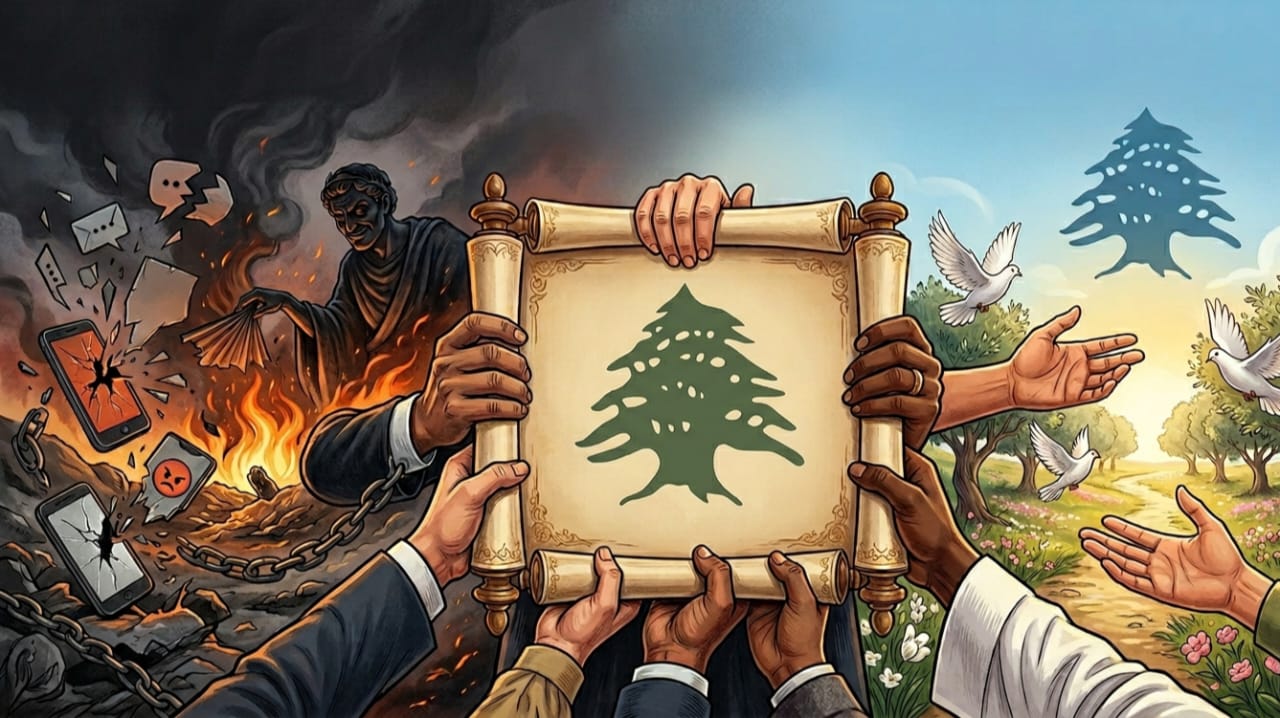
This now threatens social peace by fueling hatred in souls and recalling events from times stained with blood, smoke, and ashes.
The proponents of these ‘tongues’ have found social media to be a platform for achieving their goals, disseminating ideas, news, and information – whether true or malicious – regardless of the consequences and repercussions, which could be more deadly and destructive than cannons and rockets.
Hate speech and the culture of cancellation are rampant in Lebanon
The phenomenon of hate speech, the culture of cancellation, and the rejection of others’ right to differ are alarmingly rampant in Lebanese society. This phenomenon indicates a ‘magmatic’ accumulation that is interacting and portends a volcanic eruption.
There is no exaggeration in this statement. There are more than just ‘Basus bint Munqidh al-Tamimiyyah’ lurking and inciting.
As is well known, Basus’s incitement due to the killing of her camel led to a war, attributed to the inciter, that lasted forty years.
Anyone who assumes the role of Basus in Lebanon, from any side, is calling for war without having lost a camel or any other possession.
For this reason, urgent action must be taken to create a safety valve that prevents conflict, which is averted by actions, not merely good intentions.
In this regard, the role of spiritual authorities, universities, opinion leaders, the press and media, all professional syndicates, and experts in law, education, and sociology stands out in formulating a ‘Civil Peace’ charter based on the following axioms:
a – Rejecting hate speech.
b – Spreading values of tolerance.
c – Accepting others and the right to differ.
d – Justice that protects people’s rights and obliges them to fulfill their duties towards the law and society.
e – The right to express opinions verbally and in writing is a sacred right, but on condition of not sliding into a ‘culture of hatred’ and its destructive consequences for individuals and the nation.
f – Choosing words and phrases carefully when expressing any stance, whether in support or opposition, and avoiding hurtful and abusive language, as it is the first spark of sedition.
The notion prevalent in the literature of some platforms and ‘NGOs’ that ‘insulting’ is not defamation but a means of expressing criticism or a dissenting opinion is merely a ‘pretext’ and justification that has no place in reality.
Hate speech must not take root in our Lebanese society and become a permanent state.
Nor can it be used as a means of pressure or maneuver, especially at the political level, given its dangerous immediate and future effects.
Is there anyone who will undertake this sensitive and necessary mission, initiating a conference that results in a national-ethical-social contract to protect Lebanon from falling into the abyss of repercussions caused by hate speech?
Some consider what we present to be closer to aspirations than reality. But what prevents aspiration from becoming reality?