

Thomas Edison: The Inventor Who Lit Up the World
Thomas Alva Edison was born in Ohio in 1847. He later became known as the man who lit up the world.
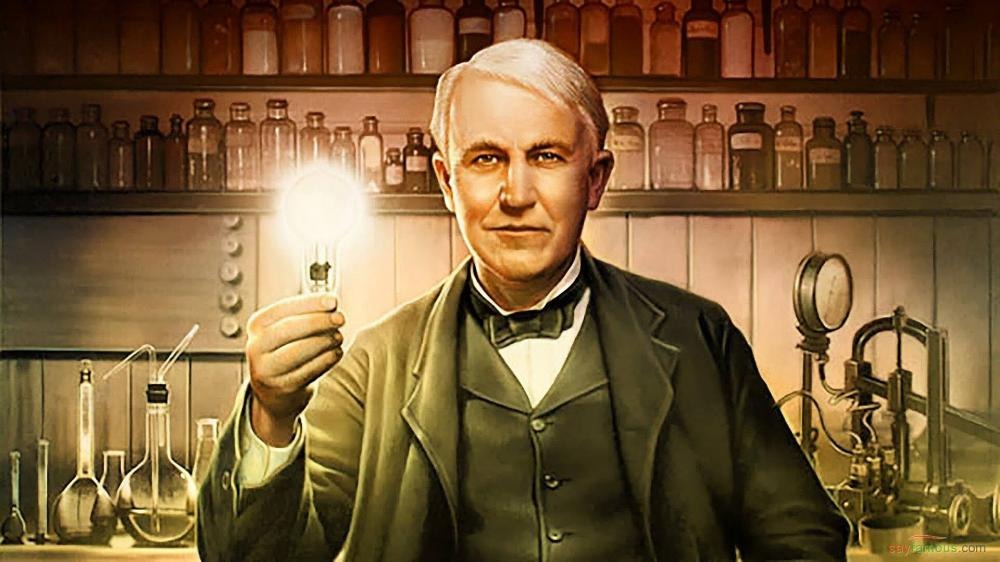
On October 21, 1879, Edison successfully tested a practical electric light bulb. This achievement transformed modern life and made him one of the most famous inventors of his time.
His inventions and scientific work immortalized his name in history.
Edison’s Family Background
Edison belonged to the first generation of his family born in the United States. His father had Dutch roots, while his mother came from a Scottish family.
His parents were Samuel Ogden Edison and Nancy Matthews Elliott. They gave him the middle name Alva to honor Captain Alva Bradley.
When Edison was seven, his father’s business failed. As a result, the family faced serious financial difficulties.
They left Milan, Ohio, and moved to Port Huron, Michigan. They hoped to find better opportunities and improve their living conditions.
Edison’s Difficult School Experience
Edison’s mother enrolled him in a local school. A pastor and his aunt managed the school.
However, Edison remained there for only three months. His teachers believed that he learned too slowly and could not continue with traditional education.
Edison was highly curious and constantly observed the world around him. He also asked many questions and showed great energy.
His teachers misunderstood these qualities. They judged him as a child who struggled to understand lessons.
According to a popular story, the school sent his mother a letter asking her to remove him. However, she chose not to tell Edison its real meaning.
Instead, she encouraged him and decided to educate him at home.
Edison Discovers the Truth
The story claims that Edison discovered the letter after his mother’s death. He reportedly cried when he read its message.
The letter allegedly stated that the school considered him mentally unfit and could no longer accept him.
Nevertheless, his mother’s support gave him confidence. She encouraged his curiosity and helped him continue learning independently.
His Early Scientific Experiments
From an early age, Edison showed a strong interest in mechanics, chemistry, and technology.
Before turning ten, he created a small laboratory in the basement of his family home. He spent many hours conducting simple experiments there.
At the age of six, Edison reportedly carried out his first scientific experiment. Unfortunately, the experiment caused a fire in his father’s grain store.
His father punished him publicly in the village square.
Despite this experience, Edison continued experimenting and learning. His curiosity eventually helped him build a successful career.
The Beginning of Edison’s Career
Edison’s professional success began after a machine broke at a gold exchange. The machine recorded changes in gold prices.
Its inventor, Dr. Laws, arrived to repair it. Edison watched the process carefully and offered to help.
Dr. Laws noticed Edison’s technical abilities and allowed him to participate in the repair. This opportunity opened the door to Edison’s future work in technology.
Edison’s First Patent
In 1868, Edison registered his first patent. He created an electrical device that recorded votes during elections.
However, members of the United States Congress refused to adopt the invention. They preferred a slower voting process that allowed more time for discussion.
Although the device failed commercially, Edison learned an important lesson. He realized that successful inventions must meet a real public demand.
The Phonograph Brings Him Fame
In 1877, Edison invented the phonograph. The device could record and reproduce sound.
The phonograph amazed the public and brought Edison international recognition. People soon gave him the nickname “The Wizard of Menlo Park.”
By the age of 33, Edison had worked on hundreds of inventions. These included developments in lighting, electricity, telegraphy, telephones, batteries, and sound recording.
The child whom teachers had underestimated eventually became one of history’s most successful inventors.
Edison Develops the Electric Light Bulb
During the summer of 1878, Edison began developing a practical electric light bulb for homes.
At the time, many homes and streets depended on gas lamps. Edison wanted to create a safer and more reliable alternative.
He tested many materials and designs before achieving a successful result. According to popular accounts, he completed hundreds of unsuccessful experiments.
Rather than viewing these attempts as failures, Edison treated each one as part of the learning process.
In October 1879, he demonstrated a practical incandescent light bulb. The invention attracted widespread media attention.
Later, Edison and his team illuminated an entire neighborhood with electric light. This achievement strengthened his reputation around the world.
Thomas Edison’s Death and Legacy
Thomas Edison died on October 18, 1931. He was 84 years old.
He passed away at his home in Llewellyn Park in West Orange, New Jersey.
Edison left behind thousands of inventions and patents. More importantly, his work helped shape the modern world.
His life demonstrated the importance of curiosity, persistence, experimentation, and family support. His achievements continue to inspire inventors and scientists today.