

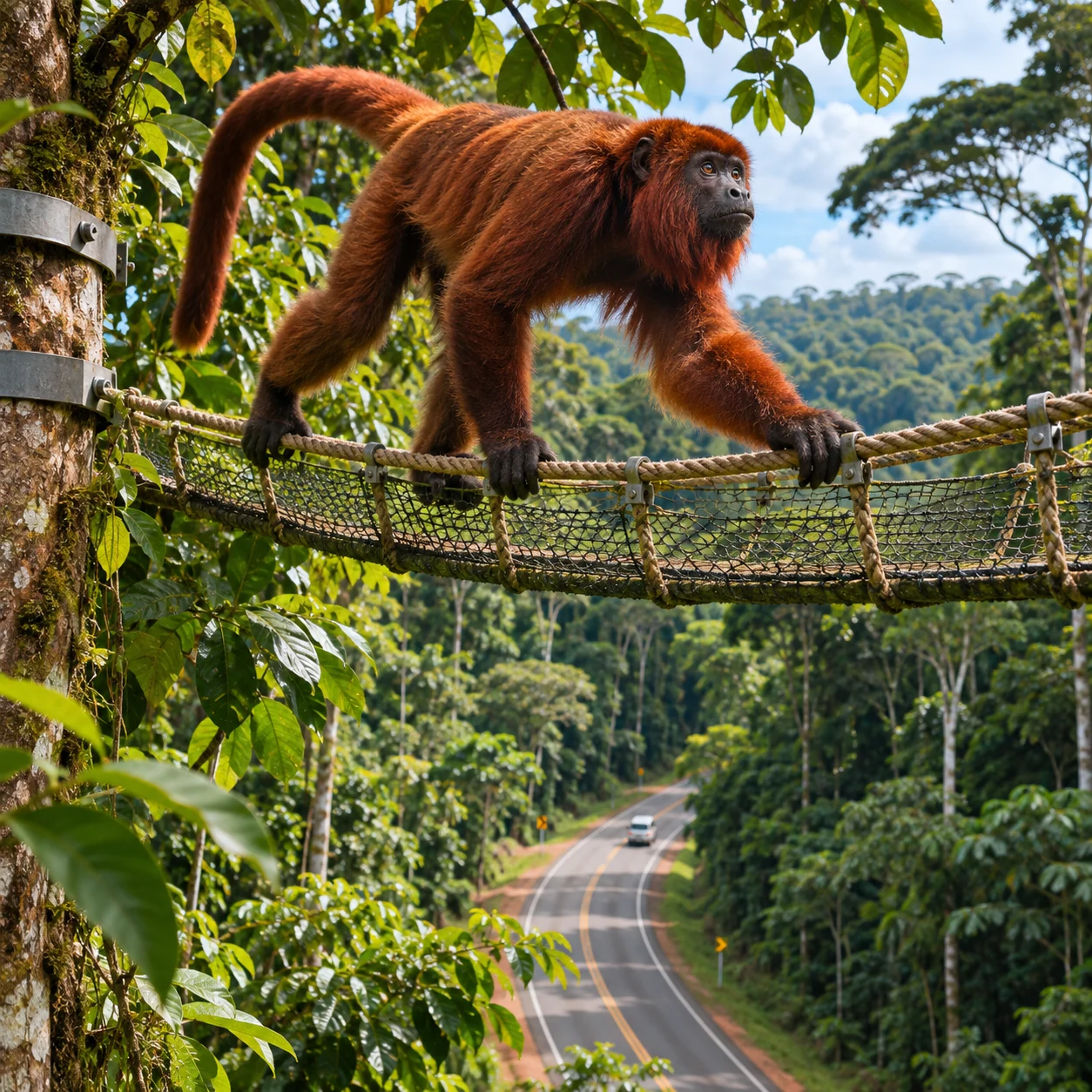

In a scientific discovery that offers hope for nature conservation, an international team of scientists has identified a new species of howler monkey in the Brazilian Amazon rainforest, scientifically named “Alouatta matogrossensis”. Surprisingly, an environmental project was already protecting these monkeys before they were officially discovered.
The “Reconecta” project builds rope bridges across roads in the Amazon to help animals move safely between trees.
Through surveillance cameras, researchers recorded the new species using one of these bridges in the Brazilian state of Mato Grosso.
The study was published in October in the journal Communications Biology. Genetic analyses showed that this species separated from its relatives more than 500,000 years ago.
Scientists also discovered another species, scientifically named “Alouatta iroi”, whose evolutionary distinctness dates back to about 700,000 years.
However, these monkeys face major environmental challenges due to deforestation, agricultural expansion, and road construction.
Researchers believe the new species is threatened with extinction, although it has not yet received an official classification.
Rope bridges in the Amazon help reduce animal deaths from road collisions, and they help preserve genetic diversity by connecting separated forest areas.
Notably, the project also protects two other monkey species that scientists discovered in 2019 and 2021.
This initiative shows that nature conservation does not always require massive projects, but rather innovative ideas that give wildlife a chance to survive.